
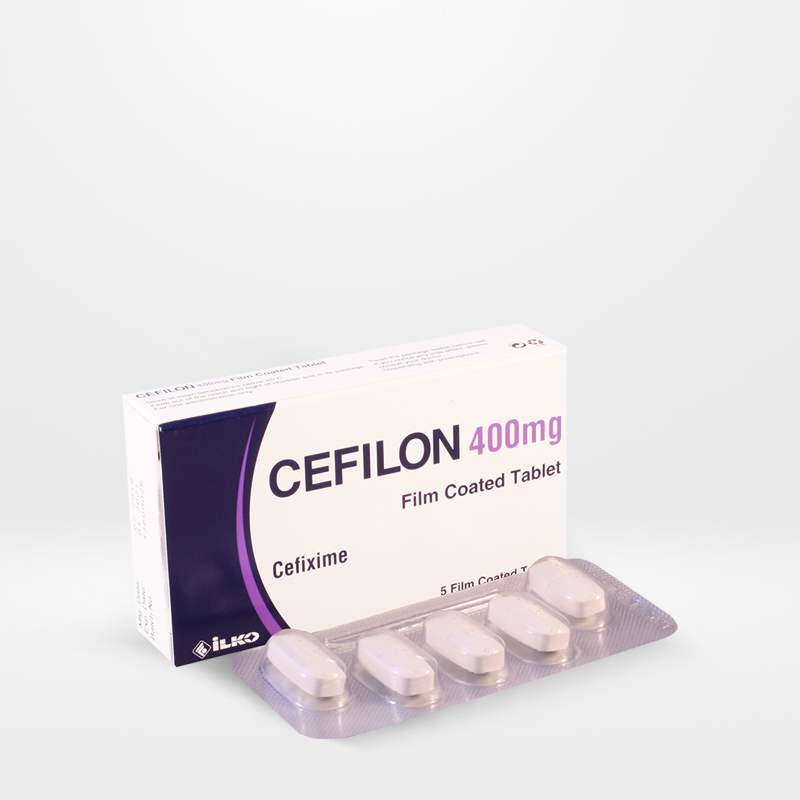
International Name (Active Ingredient): Cefixime
Clinical-Pharmacological Group: Antibacterial Agents → Beta-Lactam Antibiotics (Penicillins and Cephalosporins) → Cephalosporins → Third-Generation Cephalosporins
Manufacturer: Ilko Ilac San. Ve Tic. A.S.
Country of Manufacture: Turkey
Dosage Form: 400 mg Film-Coated Tablet №5
Dispensing Mode: Group II (Prescription Required, Form N3)
Composition and Dosage Form
Film-Coated Tablets: Pack of 5.
Each tablet contains:
- Cefixime 400 mg.
Clinical-Pharmacological Group
Third-generation cephalosporin.
Pharmacological Properties
Cefixime is a third-generation oral cephalosporin that is beta-lactamase stable, with a broad spectrum of activity and bactericidal effects against many Gram-positive and Gram-negative microorganisms.
It is effective for treating infections caused by various microorganisms, including Streptococcus spp., Neisseria gonorrhoeae, Branhamella catarrhalis, Escherichia coli, Klebsiella spp., Proteus spp., and Haemophilus influenzae. Its spectrum and MIC values are similar to other third-generation cephalosporins.
Cefixime’s bactericidal effect results from the inhibition of cell wall synthesis. It remains stable in the presence of beta-lactamase enzymes, rendering it effective against certain resistant strains.
In vitro activity has been demonstrated against:
- Gram-positive organisms: Streptococcus pyogenes, Streptococcus pneumoniae, Streptococcus agalactiae.
- Gram-negative organisms: Haemophilus influenzae, Haemophilus parainfluenzae, Branhamella catarrhalis, Neisseria gonorrhoeae, Escherichia coli, Proteus spp., Klebsiella spp., Salmonella spp., Shigella spp., Citrobacter spp., Serratia marcescens, among others.
Pharmacokinetics
After oral administration, food does not affect the rate of absorption. Cefixime is rapidly and efficiently absorbed.
- Peak serum concentrations (Cmax) are reached 3–4 hours after a single oral dose of 200 mg or 400 mg, with levels of 2–4 μg/mL and 3–5 μg/mL, respectively.
- Approximately 50% of the absorbed dose is excreted unchanged in the urine within 24 hours. Around 10% is excreted in bile.
- Cefixime has a serum protein binding rate of approximately 65%, with an elimination half-life of 3–4 hours in healthy adults.
- In renal insufficiency, the half-life extends to 6.4–11.5 hours, depending on the severity.
Cefixime is not metabolized in vivo and is minimally removed by dialysis.
Indications
Cefixime is indicated for the treatment of infections caused by susceptible microorganisms, including:
- Respiratory tract infections: Tonsillitis, pharyngitis, otitis media, sinusitis, acute pneumonia, acute and chronic bronchitis.
- Urinary tract infections: Acute cystitis, urethritis, pyelonephritis.
Dosage and Administration
Adults and children over 12 years of age:
- 400 mg daily, either as a single dose or divided into 200 mg every 12 hours.
Uncomplicated urinary tract infections:
- 200 mg once daily.
Pediatric dosage:
- For children under 12 years: 8 mg/kg/day, either as a single daily dose or divided into two doses every 12 hours.
- For children over 50 kg or older than 12 years: Use the adult dosage.
Adjust dosage in patients with renal impairment.
Adverse Reactions
Cefixime is generally well-tolerated. Most side effects are mild or moderate, including:
- Gastrointestinal effects: Diarrhea, nausea, abdominal pain, dyspepsia, flatulence, and vomiting. Rarely, pseudomembranous colitis.
- CNS effects: Headache, dizziness.
- Hypersensitivity reactions: Rash, pruritus, urticaria, arthralgia, fever.
- Hematological changes: Rare and reversible thrombocytopenia, leukopenia, eosinophilia.
In case of unexpected side effects, consult a doctor.
Contraindications
Cefixime is contraindicated in patients with a known allergy to cephalosporins.
Pregnancy and Lactation
Category B drug. While animal studies have shown no teratogenic effects, adequate studies in pregnant women are lacking. Use only if clearly needed.
Special Precautions
- Exercise caution in patients with a history of hypersensitivity to cephalosporins or penicillins due to possible cross-reactivity.
- Discontinue use immediately if allergic reactions occur.
- Adjust dosage in patients with renal impairment.
- Long-term use may lead to superinfection with resistant organisms, including Clostridium difficile, potentially resulting in pseudomembranous colitis.
In cases of severe diarrhea, discontinue treatment.
Overdose
Information on cefixime overdose is limited.
Adverse reactions observed in healthy patients after a single dose of up to 2 g of cefixime are not significantly different from those seen in patients undergoing treatment with standard doses.
Gastric lavage is recommended. There is no specific antidote. Cefixime is not effectively removed from the bloodstream by either hemodialysis or peritoneal dialysis.
Storage Conditions and Shelf Life
The medication should be stored at a temperature not exceeding 30°C, in a place out of reach of children.
Shelf life: 2 years.
Pharmacy Dispensing Conditions:
The medication is dispensed with a doctor’s prescription.