
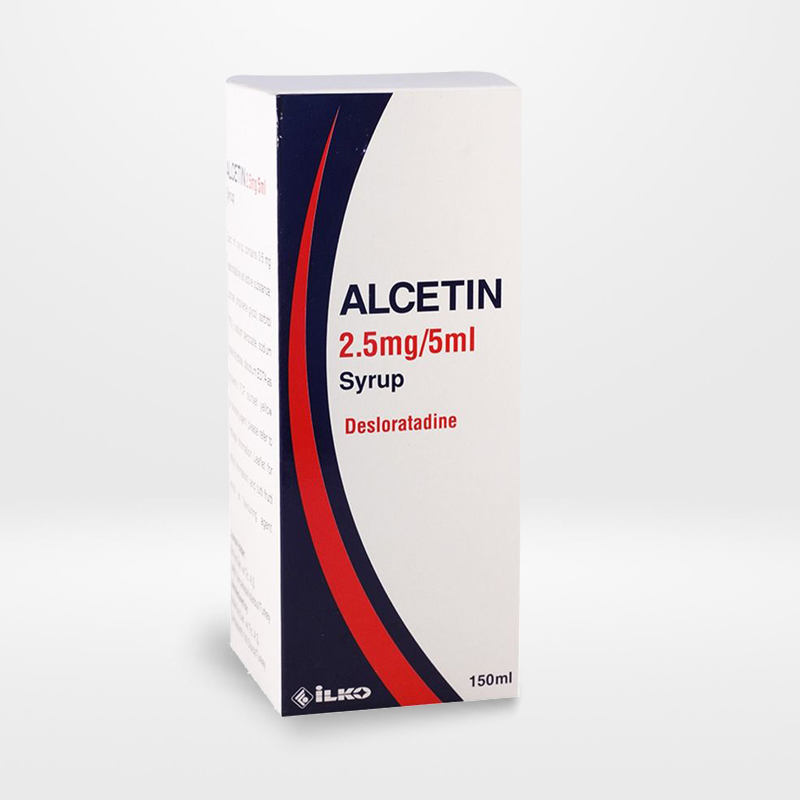
International name (active substance): desloratadine
Clinical-pharmacological group: Allergology → Histamine H1 receptor blockers → Systemic action drugs → Second-generation drugs
Manufacturer: Ilko Ilac San. Ve Tic. A.S.
Country of manufacture: Turkey
Release form: 2.5 mg/2 ml 150 ml syrup
Dispensing mode: Group III (over-the-counter)
Composition
Each tablet of Alcetin coated tablet contains 5 mg of the active ingredient desloratadine.
Excipients: Microcrystalline cellulose, calcium hydrogen phosphate, sodium starch glycolate, LS-hydroxypropylcellulose, magnesium stearate, coating powder.
Pharmacological Properties
Alcetin is a long-acting antihistamine, a peripheral H1-histamine receptor blocker. Desloratadine is the active metabolite of loratadine. It prevents the development of allergic reactions and alleviates their course, exhibiting anti-itching and anti-exudative effects, reducing capillary permeability, preventing tissue swelling, and the development of smooth muscle spasms. It does not affect the central nervous system, does not have sedative effects (does not cause drowsiness), and does not affect psychomotor reaction time. It does not cause QT interval prolongation on the electrocardiogram.
Alcetin inhibits various reactions in the body that underlie the development of allergic inflammatory processes, specifically: the release of pro-inflammatory cytokines (including interleukin-4, IL-6, IL-8, IL-13), the release of pro-inflammatory chemokines, the production of superoxide anions by activated polymorphonuclear neutrophils, eosinophil chemotaxis and adhesion, the expression of adhesion molecules (P-selectin, etc.), and the IgE-dependent release of histamine, prostaglandin D2, and leukotriene C4.
Alcetin begins its action approximately 30 minutes after administration and provides long-lasting (at least 24 hours) anti-allergic and anti-inflammatory effects.
Pharmacokinetics
Orally administered desloratadine is well absorbed from the gastrointestinal tract. It can be detected in the blood plasma within 30 minutes, with a peak concentration (Cmax) reached in 3 hours.
It binds to plasma proteins in 83-87% of cases. Food does not affect its distribution in the body. It does not cross the blood-brain barrier. It undergoes biotransformation via hydroxylation, producing a glucuronidated metabolite.
It is mainly eliminated from the body as a glucuronidated metabolite, with a small amount excreted unchanged. The half-life (T1/2) is on average 27 hours (range 20-30 hours).
Indications
- Seasonal or chronic (year-round) allergic rhinitis (relief or disappearance of sneezing, “nasal congestion”, nasal discharge, itching of the nose, throat, eyes, redness, and itching).
- Chronic idiopathic urticaria (reduction or disappearance of itching and rash).
Dosage and Administration
Tablets are taken orally, preferably at the same time each day, with a small amount of water, independently of meals.
In adults and children over 12 years old: 5 mg once a day.
In children aged 6-12 years: 2.5 mg once a day.
In children aged 1-6 years: 1.25 mg once a day.
Side Effects
There are no clinically significant side effects of desloratadine.
Possible side effects: feeling of fatigue, dry mouth, headache.
Very rarely: tachycardia, palpitations, increased liver enzyme activity, increased bilirubin concentration, allergic reactions, rash.
Contraindications
- Hypersensitivity to the components of the preparation.
- Lactation period.
- Pregnancy.
- Children under 1 year old.
Use with caution in severe renal insufficiency.
Precautions
The safety and efficacy of desloratadine have not been established for children under 1 year of age.
Use with caution in patients with severe renal insufficiency.
Pregnancy and Lactation
The safety of desloratadine during pregnancy has not been studied, so its use is not recommended.
Desloratadine is excreted in breast milk, so its use is not recommended during lactation.
Special Warnings
Effect on the ability to drive and use machinery:
At the recommended dose, no effect on the ability to drive or use mechanical equipment has been observed.
Overdose
Symptoms: No symptoms have been observed when taking five times the recommended dose of 5 mg of desloratadine.
No clinically significant cardiovascular effects have been observed with a daily dose of 20 mg for 14 days, and no QT interval prolongation or serious side effects were reported with 45 mg/day for 10 days.
Treatment: In case of accidental overdose – gastric lavage, activated charcoal; symptomatic treatment as needed.
Hemodialysis is ineffective; the effectiveness of peritoneal dialysis has not been established.
Interaction with Other Medications
No clinically significant interactions with other medications have been observed.
Desloratadine does not enhance the effects of ethanol on the central nervous system.
Food intake does not affect the effectiveness of the medication.
Storage Conditions and Shelf Life
Shelf life: 2 years.
Store at 15-25°C.
Keep out of reach of children!
Pharmacy Dispensation
Pharmaceutical product group III (can be used without a prescription).