
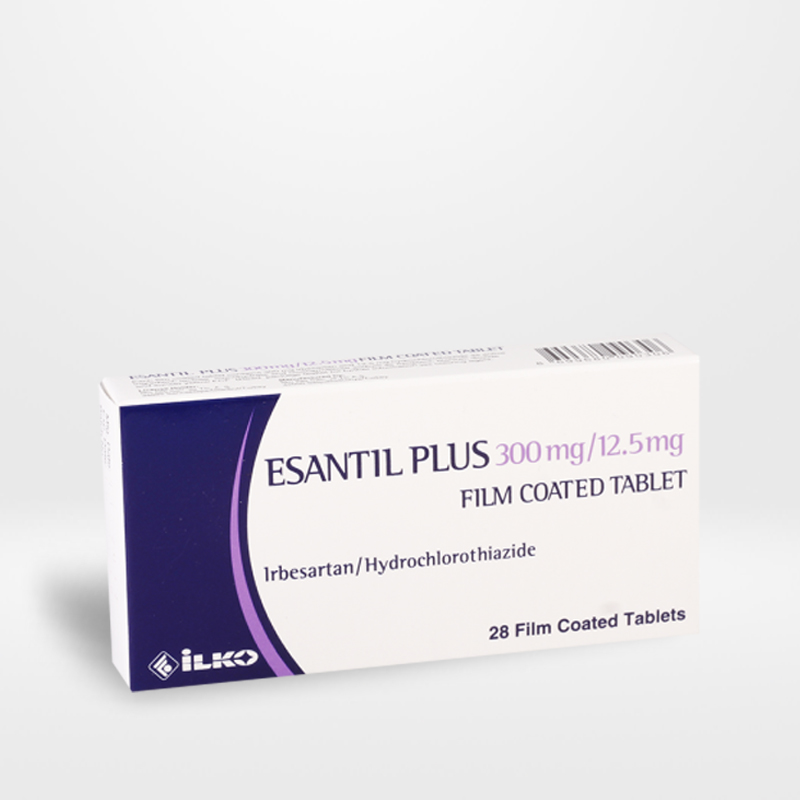
International Name (Active Ingredients): Hydrochlorothiazide, Irbesartan
Clinical-Pharmacological Group: Cardiovascular system → Angiotensin II receptor antagonists
Manufacturer: Ilko
Country of Manufacture: Turkey
Dosage Form: 300mg +12.5 mg coated tablet # 28
Dispensing Mode: Group II (dispensed with prescription, form N3)
Pharmacological Properties: The combination of active ingredients in Esantil Plus has an additional antihypertensive effect, effectively lowering blood arterial pressure more than the individual components.
Pharmacodynamics: Esantil Plus is a potent, orally active, selective antagonist of the angiotensin II receptor (AT1 subtype). Angiotensin II is a strong vasoconstrictor, formed from angiotensin I through the reaction catalyzed by angiotensin-converting enzyme (ACE). Angiotensin II is a key pressor agent in the renin-angiotensin system (RAS) and stimulates aldosterone synthesis, secretion from the adrenal cortex, cardiac contractility, sodium reabsorption in the kidneys, sympathetic nervous system activity, and smooth muscle cell growth. Irbesartan blocks vasoconstriction and aldosterone-secreting effects of angiotensin II through selective binding to AT1 receptors.
Irbesartan is a competitive antagonist of AT1 receptors with a much greater affinity (800 times more) for AT1 receptors than AT2 receptors, without agonistic activity. Blockage of AT1 receptors mitigates the negative effect of angiotensin II on renin secretion, but elevated plasma renin activity and circulating angiotensin II do not affect the blood pressure-lowering effect of irbesartan.
Irbesartan does not inhibit ACE or renin and has no effect on other hormonal receptors or ion channels involved in cardiovascular regulation and sodium homeostasis. Since irbesartan does not inhibit ACE, it does not affect bradykinin responses.
Hydrochlorothiazide is a thiazide diuretic. After oral administration, diuresis begins within 2 hours, and maximal effect occurs at 4 hours, with activity lasting for approximately 6-12 hours. Thiazides affect electrolyte reabsorption in the renal tubules, directly increasing sodium and chloride excretion in nearly equal amounts. Hydrochlorothiazide’s diuretic action reduces plasma volume, increases plasma renin activity, and stimulates aldosterone secretion, increasing potassium and bicarbonate loss in urine and decreasing serum potassium levels. The exact mechanism of the antihypertensive action of thiazides is not fully understood.
Pharmacokinetics: Irbesartan is an orally active drug that does not require metabolic conversion to its active form. Its oral absorption is rapid and complete, with an average absolute bioavailability of 60-80%. After oral administration, peak plasma concentration is reached within 1.5-2 hours. Food does not affect the bioavailability of irbesartan. Within therapeutic doses, irbesartan exhibits linear pharmacokinetics. The half-life of irbesartan is 11-15 hours, and steady-state concentrations are reached within 3 days. There is minimal accumulation (<20%) with once-daily dosing.
Irbesartan is metabolized by glucuronidation and oxidation. After oral or intravenous administration of radiolabeled irbesartan, approximately 80% of the circulating radioactivity corresponds to unchanged irbesartan. The major circulating metabolite is an inactive glucuronide conjugate (about 6%). Other oxidative metabolites are pharmacologically insignificant.
Irbesartan and its metabolites are excreted in bile and urine. After oral or intravenous administration, approximately 20% of radioactivity is recovered in urine, with the remainder in feces as unchanged irbesartan or its glucuronide form.
In vitro studies of cytochrome P450 enzyme oxidation showed that irbesartan is primarily metabolized by CYP2C9; metabolism by CYP3A4 is insignificant. Irbesartan does not significantly influence the metabolism of other drugs commonly associated with cytochrome P450 enzymes.
Irbesartan binds extensively to plasma proteins (primarily albumin and α1-acid glycoprotein), with a minor binding to blood cellular components. Its volume of distribution is 53-93 liters. The total plasma and renal clearance rates are 157-176 mL/min and 3.0-3.5 mL/min, respectively. With repeated dosing, it accumulates clinically insignificantly.
Studies in animals show that radiolabeled irbesartan weakly crosses the blood-brain barrier and the placenta. Irbesartan is excreted in the milk of lactating rats.
Hydrochlorothiazide: Plasma levels of hydrochlorothiazide vary with a half-life ranging between 5.6 and 14.8 hours. Hydrochlorothiazide is not metabolized but is rapidly excreted by the kidneys. At least 61% of an oral dose is excreted unchanged within 24 hours. Hydrochlorothiazide crosses the placenta but not the blood-brain barrier and is excreted in breast milk.
Indications: Esantil-Plus is indicated for the treatment of hypertension. This fixed-dose combination is not recommended for use at the initiation of treatment.
Contraindications: Esantil-Plus is contraindicated in patients with hypersensitivity to any component of this product. Due to the hydrochlorothiazide component, it is contraindicated in patients with anuria or hypersensitivity to sulfonamide-derived drugs.
Precautions: Fetal/Newborn morbidity and mortality: Drugs that act directly on the renin-angiotensin system, when used in pregnant women, can cause fetal and neonatal morbidity and mortality. Several cases have been reported in the literature regarding patients receiving angiotensin-converting enzyme inhibitors. If pregnancy is confirmed, the drug should be discontinued immediately.
In the second and third trimesters of pregnancy, drugs acting directly on the renin-angiotensin system are associated with fetal and neonatal injury, including hypotension, skull hypoplasia, anuria, reversible and irreversible kidney defects, and mortality. Oligohydramnios has also been reported, likely due to reduced fetal kidney function. This can lead to limb contractures, skull-facial deformities, and pulmonary hypoplasia. Additionally, prematurity, intrauterine growth restriction, and ductus arteriosus have been observed, though causality with the medication is not established.
Hypotension in hypovolemic and salt-deficient patients: Severe arterial hypotension is rarely observed in patients with complicated hypertension treated with irbesartan alone (<0.1%) or in combination with hydrochlorothiazide (about 1%). Initiating antihypertensive treatment can cause symptomatic hypotension in patients with intravascular hypovolemia or salt depletion, e.g., in patients treated with strong diuretics or dialysis. Such hypovolemia should be corrected before starting antihypertensive treatment.
If hypotension develops, the patient should be placed in a horizontal position and, if necessary, receive intravenous saline infusion. Transient hypotensive effects are not a contraindication for continuing treatment, as they can resolve once blood pressure stabilizes.
Hydrochlorothiazide: Liver: Thiazides should be used with caution in patients with liver dysfunction or progressive liver disease, as even small changes in fluid and electrolyte balance can accelerate the development of hepatic coma.
Side Effects: Generally, the combination of irbesartan and hydrochlorothiazide is well tolerated. Most side effects were mild and transient, requiring no discontinuation of treatment. In placebo-controlled studies in hypertensive patients, the frequency of side effects was similar between the irbesartan/hydrochlorothiazide and placebo groups.
In controlled clinical trials, discontinuation of the combination therapy due to side effects occurred in only 3.6% of patients, significantly lower than the 6.8% of placebo-treated patients who discontinued treatment.
Common side effects (≥1%): General: Chest pain (2%), fatigue (7%), flu (3%) Cardiovascular: Edema (1%), tachycardia (1%) Gastrointestinal: Abdominal pain (2%), dyspepsia/heartburn (2%), nausea/vomiting (3%) Immunological: Allergy (1%) Musculoskeletal: Myalgia (7%) Nervous system: Dizziness (8%), orthostatic dizziness (1%) Urinary: Pathological urination (2%)
Other side effects noted in post-marketing studies include urticaria, angioedema (including facial, lip, throat, and/or tongue swelling), and rarely, hyperkalemia.
Laboratory parameters: In controlled clinical studies, clinically significant changes in standard laboratory parameters were rarely associated with the use of the irbesartan-hydrochlorothiazide combination.
Blood creatinine, BUN: In patients with essential hypertension treated with the irbesartan-hydrochlorothiazide combination, slight increases in BUN and serum creatinine were observed in 2.3% and 1.1% of cases, respectively.
Hemoglobin: A clinically insignificant average decrease of about 0.2 g/dL was observed in patients treated with the irbesartan-hydrochlorothiazide combination, compared to a 0.4 g/dL decrease in patients receiving placebo.
Liver function tests: Rare increases in liver enzymes or serum bilirubin were observed.
Overdose:
Irbesartan
There is no available data on overdose in humans. However, daily doses of 900 mg for 8 weeks are well tolerated. The most likely symptoms of overdose are expected to be hypotension and tachycardia; bradycardia may also develop during an overdose. Irbesartan is not removed by hemodialysis.
Hydrochlorothiazide
The most common signs and symptoms of overdose in humans are caused by electrolyte imbalance (hypokalemia, hypochloremia, hyponatremia) and dehydration, which result from excessive diuresis. When digoxin is used, hypokalemia may exacerbate cardiac arrhythmias. The extent of hydrochlorothiazide removal by hemodialysis is not established.
Storage conditions:
Store at room temperature up to 25ºC in its original packaging. Keep out of reach of children.