
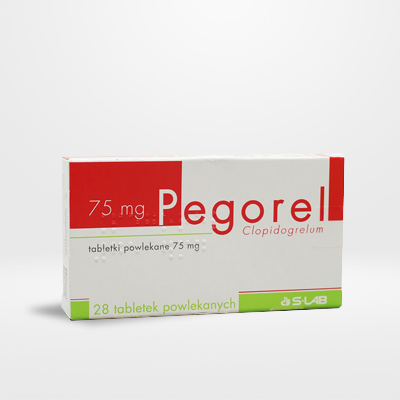
International Name (Active Ingredient): clopidogrel
Clinical-Pharmacological Group: Hemostasis → Antithrombotic and Anticoagulant Agents → Antiplatelet Agents
Manufacturer: S-Lab
Country of Manufacture: Poland
Dosage Form: 75 mg tablet #28
Prescription Regimen: Group II (to be dispensed with a prescription form N3)
Top of Form
Each tablet contains:
Clopidogrel 75 mg
Excipients: The core contains mannitol, macrogol 6000, microcrystalline cellulose, hydrogenated castor oil, hydroxypropylcellulose, and the coating contains hypromellose, triacetin, titanium dioxide (E171), red iron oxide (E172), carnauba wax.
Clinical-Pharmacological Group
Platelet aggregation inhibitor.
Pharmacological Properties
Pegoreli selectively inhibits the binding of adenosine diphosphate (ADP) to its platelet receptors and the subsequent activation of the glycoprotein GPIIb/IIIa complex by ADP, leading to a reduction in platelet aggregation. The inhibition of platelet aggregation requires the bioactivation of the drug. Pegoreli also inhibits platelet aggregation induced by other agonists released by ADP. As a result of inhibiting increased platelet activity, Pegoreli induces irreversible changes in the platelets, which remain damaged for the duration of their life cycle. Normal platelet function is restored at a rate corresponding to the rate of platelet turnover.
In clinical studies, repeated doses of 75 mg of the drug resulted in significant inhibition of ADP-induced platelet aggregation within the first day. The inhibitory effect progressively strengthened, reaching a steady state after 3-7 days. The average inhibition level ranged from 40% to 60% with a 75 mg daily dose. After discontinuation of treatment, platelet aggregation and bleeding time gradually returned to baseline levels, typically within 5 days.
Pharmacokinetics
Pegoreli is rapidly absorbed following oral administration of a 75 mg dose, although the plasma concentration of the active ingredient is very low, not reaching detectable levels (0.00025 mg/L) after 2 hours. The drug is absorbed at about 50% (based on excretion of clopidogrel metabolites in urine).
Pegoreli undergoes extensive metabolism in the liver. Its main metabolite, the carboxylic acid derivative, is inactive and accounts for 85% of circulating compounds. The maximum plasma concentration of this metabolite (approximately 3 mg/L after repeated 75 mg doses) occurs about 1 hour after administration.
Clopidogrel is a prodrug. Its active metabolite, a thiol derivative, is formed by oxidation of clopidogrel to clopidogrel-2-oxo-clopidogrel and subsequent hydrolysis. The oxidation process is primarily regulated by cytochrome P450 isoenzymes 2B6 and 3A4, with lesser contributions from 1A1, 1A2, and 1C19. The active thiol metabolite, isolated in vitro, rapidly and irreversibly binds to platelet receptors, leading to inhibition of platelet aggregation. This metabolite is not detectable in plasma.
Indications
The drug is used for the prevention of atherosclerotic disorders:
- After myocardial infarction (from a few days up to at least 35 days), ischemic stroke (from 7 days up to 6 months), or diagnosed peripheral arterial disease;
- In patients with acute coronary syndrome without significant ST-segment elevation (unstable angina or non-Q wave myocardial infarction), in combination with acetylsalicylic acid.
Dosage Regimen
For adults and elderly patients, the drug is administered once daily, regardless of meals, at a dose of 75 mg per day.
In patients with acute coronary syndrome without significant ST-segment elevation (unstable angina or non-Q wave myocardial infarction), it is administered as a loading dose of 300 mg once, followed by 75 mg once daily (in combination with acetylsalicylic acid at 75-325 mg daily). High doses of the drug may increase the risk of bleeding, so acetylsalicylic acid should not exceed 100 mg daily. The duration of treatment is not formally established.
Contraindications
- Hypersensitivity to the drug or any of its components;
- Severe liver dysfunction;
- Acute bleeding caused by peptic ulcer or cerebral hemorrhage;
- Lactation period.
There is no safety or efficacy data for use in children or adolescents under 18 years of age.
Pregnancy and Lactation
The use of Pegoreli during pregnancy is not recommended.
It is not known whether the drug is excreted in breast milk.
Special Precautions
During treatment, blood tests should be performed immediately if bleeding or hematological side effects occur. Like other antiplatelet agents, clopidogrel should be used with caution in patients with an increased risk of bleeding, due to trauma, surgery, or other pathological conditions, or when combined with acetylsalicylic acid, non-steroidal anti-inflammatory drugs, GP IIb/IIIa inhibitors, or thrombolytic drugs. Patient condition should be carefully monitored for signs of bleeding, including hidden bleeding, especially during the first few weeks of treatment and/or invasive heart procedures or surgery.
Concurrent use of warfarin and clopidogrel is not recommended as this combination increases bleeding intensity.
In cases of surgery where antiplatelet action is undesirable, treatment with clopidogrel should be discontinued at least 7 days before surgery.
Clopidogrel should be used cautiously in patients with a tendency to bleed (especially from the gastrointestinal tract or ocular bleeding), as it prolongs bleeding time.
Patients undergoing surgery must inform the healthcare provider or dentist about using clopidogrel.
Long-term use of clopidogrel may lead to thrombotic thrombocytopenic purpura, characterized by thrombocytopenia, microangiopathic hemolytic anemia, neurological disturbances, renal dysfunction, or hyperthermia. This condition requires immediate intervention, including plasmapheresis.
In acute myocardial infarction with ST-segment elevation, starting clopidogrel therapy several days after the infarction is not recommended.
Due to lack of data, the use of Pegoreli for acute ischemic stroke is not recommended.
In patients with moderate liver dysfunction, Pegoreli should be used with caution, as they may develop hemorrhagic diathesis.
The drug does not affect the ability to drive or concentrate.
Overdose
There have been no significant side effects observed with high doses of the drug, and no specific antidote exists. In cases requiring rapid correction of prolonged bleeding time, the effects of clopidogrel can be reversed by platelet transfusion.
Storage Conditions and Shelf Life
No special storage conditions are required.
Shelf life: 3 years.