
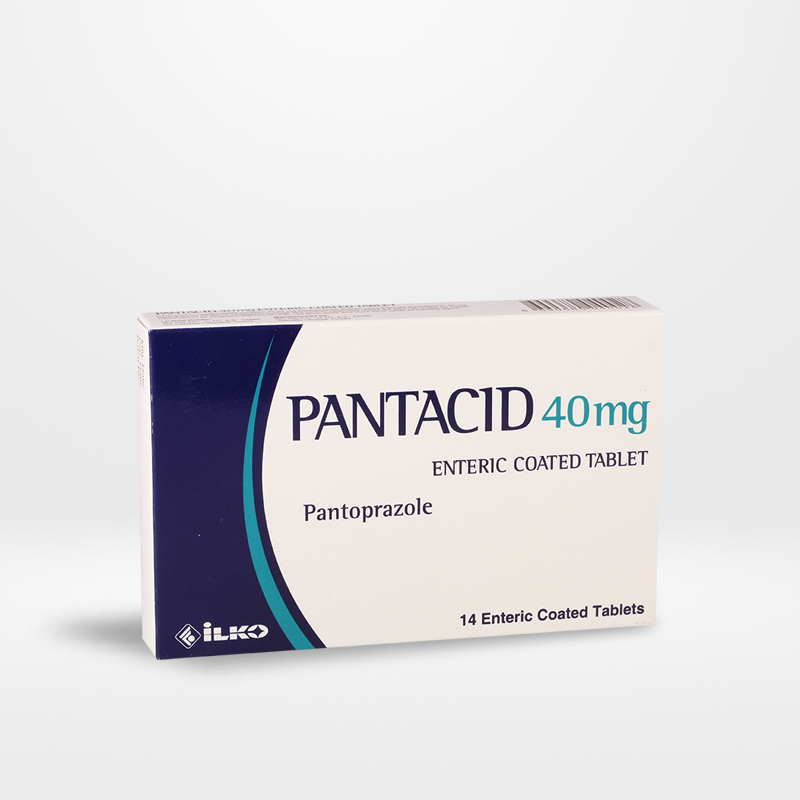
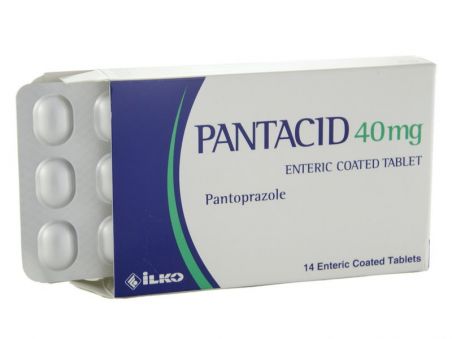
International Name (Active Ingredient): Pantoprazole
Clinical-Pharmacological Group: Gastroenterology, Hepatology → Proton Pump Inhibitors
Manufacturer: Ilko Ilac San. Ve Tic. A.S.
Country of Origin: Turkey
Dosage Form: 40 mg Tablet №14
Dispensing Mode: Group III (Over-the-counter).
Composition:
Each Pantacid 40 mg enteric-coated tablet contains 45.30 mg of pantoprazole sodium sesquihydrate, equivalent to 40 mg of pantoprazole as the active ingredient.
Pharmacological Properties:
Pharmacodynamic Properties:
Pantoprazole, a novel member of the benzimidazole class, inhibits the final stage of gastric acid production by forming a covalent bond with the (H⁺-K⁺)-ATPase enzyme system on the secretory surface of gastric parietal cells. It suppresses both basal and stimulated acid secretion.
Pantoprazole’s acid-suppressive effect lasts for over 24 hours. Gastric acid secretion typically returns to normal within a week after the last dose. No rebound hypersecretion has been observed.
Transient increases in serum gastrin levels are similar to those seen with other proton pump inhibitors and H₂ receptor blockers. Gastrin levels normalize after discontinuation of treatment.
Pharmacokinetic Properties:
Pantoprazole is rapidly absorbed from the gastrointestinal tract, with an absolute bioavailability of approximately 77% following single or multiple oral 40 mg doses.
- Peak Concentration (Cmax): 2.09 µg/mL
- Time to Peak Concentration (Tmax): 2.8 hours
Approximately 98% of pantoprazole binds to plasma proteins, predominantly albumin.
- Half-life (T½): ~1.9 hours
Despite its short half-life, pantoprazole’s antisecretory effects persist for more than 24 hours due to its covalent binding to the (H⁺-K⁺)-ATPase enzyme. - Volume of Distribution (Vd): 11-23 L
Pantoprazole is metabolized in the liver via CYP2C19 to its main metabolite, desmethylpantoprazole, and other metabolites. About 80% of an oral dose is excreted in urine, and 20% in feces through biliary excretion.
No unchanged pantoprazole is found in urine.
Mild to moderate reductions in plasma clearance have been observed in elderly individuals due to lower hepatic blood flow and reduced liver mass.
Indications:
- Gastric and duodenal ulcers
- Gastroesophageal reflux disease (GERD) and erosive esophagitis
- Pathological hypersecretory conditions, including Zollinger-Ellison syndrome
- H. pylori eradication in combination with suitable antibiotics for patients with duodenal ulcers.
Contraindications:
Pantoprazole is contraindicated in patients with known hypersensitivity to any component of the drug or those with severe liver failure.
Warnings and Precautions:
- Liver Impairment: Dose adjustment is not required.
- Renal Impairment: No dose adjustment is necessary, but the daily dose should not exceed 40 mg.
- Prolonged Use: Symptomatic response to pantoprazole does not rule out malignant gastric conditions.
Pregnancy and Lactation:
- Pregnancy Category B: Adequate studies in pregnant women are lacking. Pantoprazole should only be used if absolutely necessary.
- Lactation: It is unknown if pantoprazole is excreted in breast milk. A decision should be made to discontinue breastfeeding or the drug, considering the drug’s importance to the mother.
Use in Children:
The safety and efficacy of pantoprazole in pediatric populations have not been established.
Adverse Effects:
Pantoprazole is generally well tolerated. Rare side effects include:
- Diarrhea, abdominal pain, flatulence
- Nausea, dizziness, headache
- Blurred vision, rash, itching, fever, and edema
Drug Interactions:
Pantoprazole should not be used with antacids.
It does not exhibit clinically significant interactions with warfarin, phenytoin, diazepam, or theophylline. However, it may affect the absorption of drugs where gastric pH is crucial, such as ketoconazole and iron salts.
Dosage and Administration:
- Duodenal/Gastric Ulcers:
40 mg orally once daily for 4 weeks. Treatment may be extended for another 4 weeks if necessary. - GERD/Erosive Esophagitis:
40 mg orally once daily for 8 weeks, with an additional 4-week course if required. - Zollinger-Ellison Syndrome:
Initial dose: 40 mg twice daily. Maintenance doses up to 240 mg/day may be required. - H. pylori Eradication:
40 mg twice daily with antibiotics for 7 days:
-
- 1000 mg amoxicillin + 500 mg clarithromycin, or
- 500 mg metronidazole + 500 mg clarithromycin, or
- 1000 mg amoxicillin + 500 mg metronidazole
Take tablets whole before meals with a full glass of water.
Overdose:
Limited data on pantoprazole overdose. There is no antidote, and it is not removed by dialysis. Treatment should be symptomatic and supportive.
Storage Conditions:
Store below 25°C, out of the reach of children.
Packaging:
Available in blister packs of 7, 14, or 28 tablets.
Shelf Life:
2 years.
Prescription Status:
Dispensed by prescription only.